Williamsburg · plate 05
The Governor's Palace and its gardens
The house of Virginia's royal governors burned in 1781 and was rebuilt in the 1930s on its excavated foundations. It is a show of power, a working household and a careful piece of detective work.
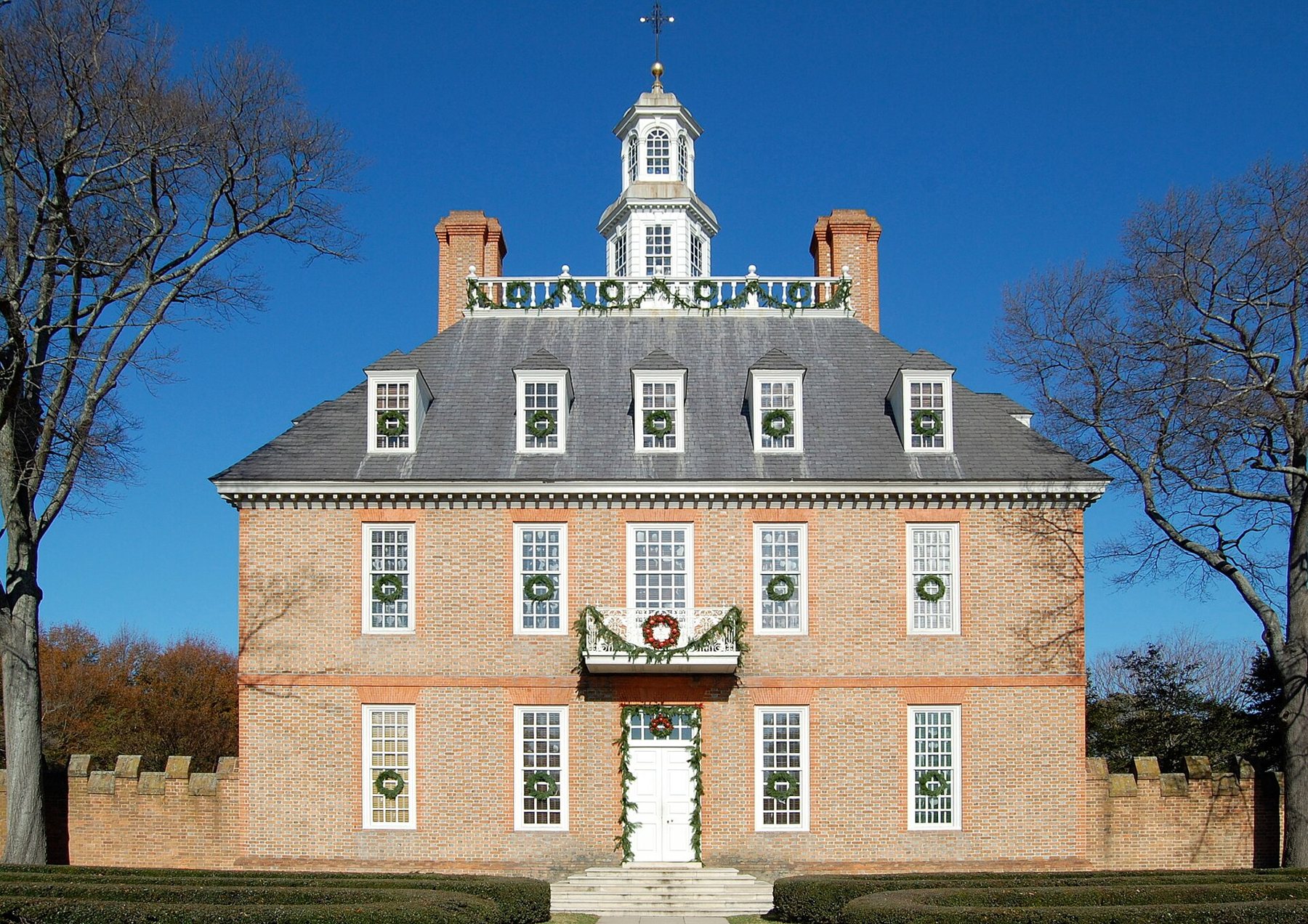
At the north end of the Palace Green, a long lawn that runs off Duke of Gloucester Street near Bruton Parish Church, stands the largest house in colonial Williamsburg. It was built as the official residence of the royal governors of Virginia, the Crown's representatives in the colony, and it was meant to impress. The building you see today is not the original. The first palace burned in 1781, and what stands now was rebuilt in the early 1930s on the old foundations. How that reconstruction was done is part of the reason to visit.
A house for the Crown's man
The General Assembly agreed to build a governor's house in 1706, soon after the capital moved from Jamestown to Williamsburg. Work went slowly and cost far more than planned, and the building was not finished until around 1722, under Governor Alexander Spotswood, who took a close interest in its design and gardens. The result was a brick house of two main storeys with a cupola on the roof, set between two smaller flanking buildings, with a forecourt, outbuildings and formal gardens stretching behind.
Several royal governors lived here, among them Spotswood, William Gooch, Robert Dinwiddie, Francis Fauquier, Lord Botetourt and Lord Dunmore. Botetourt was well liked and died in the palace in 1770; he is buried in the chapel of the Wren Building at the College of William & Mary. Dunmore was the last. In April 1775 he had the colony's gunpowder removed from the Magazine, and in June, with tensions rising, he left the palace and took refuge on a warship. In November he issued a proclamation offering freedom to enslaved people held by rebels if they would fight for the Crown, which drew hundreds to his side and alarmed Virginia's planters.
After independence the palace became the home of the first two governors of the new Commonwealth, Patrick Henry and Thomas Jefferson. When the capital moved to Richmond in 1780 the house stood mostly empty.
Who kept the household running
A palace of this size depended on many people. The governors brought household staff with them, hired local workers and relied on enslaved men and women who cooked, cleaned, washed, served at table, worked in the stables and tended the gardens. Their work made the dinners, balls and receptions possible. Most of their names are not well recorded, though inventories and accounts mention some of them. The museum's interpreters now speak about these workers as well as the governors, and the outbuildings behind the house, the kitchen, laundry and stable among them, are where much of that work was done.
The plate on free and enslaved Williamsburg tells the wider story of the town's enslaved majority and its free Black residents.
Fire, and finding the palace again
After the siege of Yorktown in October 1781, the empty palace was used as a hospital for wounded American soldiers. On the night of 22 December 1781 it caught fire and burned to the ground. The patients were carried out, and the cause of the fire was never firmly established. Later, more than a hundred and fifty graves were found in the garden, thought to be those of soldiers who died in the hospital and of a few others. Over the following decades the remaining outbuildings were pulled down, and by the twentieth century the site had been built over.
When the restoration of Williamsburg began, the palace was one of its most ambitious projects. Excavation in 1930 uncovered the foundations, the cellars and many fragments of the original building. Two documents filled in the rest. One was a floor plan drawn by Jefferson, probably around 1779, when he was thinking of altering the house. The other was a copperplate engraving found in 1929 in the Bodleian Library at Oxford, which showed the front of the palace and other public buildings of the town. Using these, the excavated evidence and the study of surviving houses of the period, the palace was rebuilt and opened in 1934.
A neighbouring plate · WilliamsburgThe Wren Building and the college at the west endThe oldest college building still in use in AmericaThe interior was furnished largely on the basis of a detailed room-by-room inventory made after Botetourt's death in 1770. That list, recording furniture, pictures, weapons, linen and kitchen goods, gave the museum an unusually exact guide to how the house was used. Many pieces are period antiques of English or colonial make; few, if any, belonged to the palace itself.
The building you see today is not the original.
Muskets on the walls
The first room most visitors see is the entrance hall, and it is meant to make a point. Its walls and ceiling are covered with muskets, pistols and swords arranged in fans, circles and rows. The display follows evidence of a similar arrangement in the original hall, and it is a statement of royal authority: anyone who came to see the governor passed under the weapons of the Crown on the way. Beyond the hall, the rooms move from public to private, from the parlour and dining room to the ballroom and supper room added later in the eighteenth century, and up to the bedchambers.
Visits to the interior are usually guided and timed, and they need a ticket from the living-history museum. Groups are small, and on busy days you may wait. Check current arrangements before you go.
The gardens, the maze and the canal
Behind the house the gardens run north and east over about ten acres. They are a reconstruction in a looser sense than the building. Excavation found some walls, paths and planting beds, but much of the design was worked out in the 1930s by the landscape architect Arthur Shurcliff, drawing on English and Dutch garden fashions of the early 1700s. They are best seen as a twentieth-century garden in an early eighteenth-century style.
Formal parterres with clipped box and topiary lie closest to the house. Beyond them are a bowling green, a fruit garden and a kitchen garden. A holly maze, laid out in the manner of the one at Hampton Court in England, is popular with children and gives a good sense of the formality of the place. Further down the slope, a long rectangular canal reflects the trees, and a low mound beside it covers an ice house where winter ice was stored for summer use. The far end of the garden is quieter, and in spring and autumn it is one of the most peaceful corners of town.
The paths run in straight lines and the views are planned. From the garden door of the house you look straight down a central walk, and from the far end you look back up at the house over the clipped beds. Much of the planting uses species known to have grown in colonial Virginia gardens, with some later choices where the old ones are hard to find. The gardens change through the year, with bulbs and flowering trees in spring, roses in early summer and red berries on the holly in winter.
From the palace, walk back down the green to Duke of Gloucester Street and east to the Capitol, where the assembly whose leaders the governors had to deal with met. The story of how the colony's last royal governor lost Virginia ends a few miles away, on the siege lines at Yorktown.