Williamsburg · plate 04
Duke of Gloucester Street, end to end
One straight street, about a mile long, runs from the Capitol to the college. Walk it slowly and you pass Virginia's colonial capital as it was rebuilt in the twentieth century, original buildings and all.
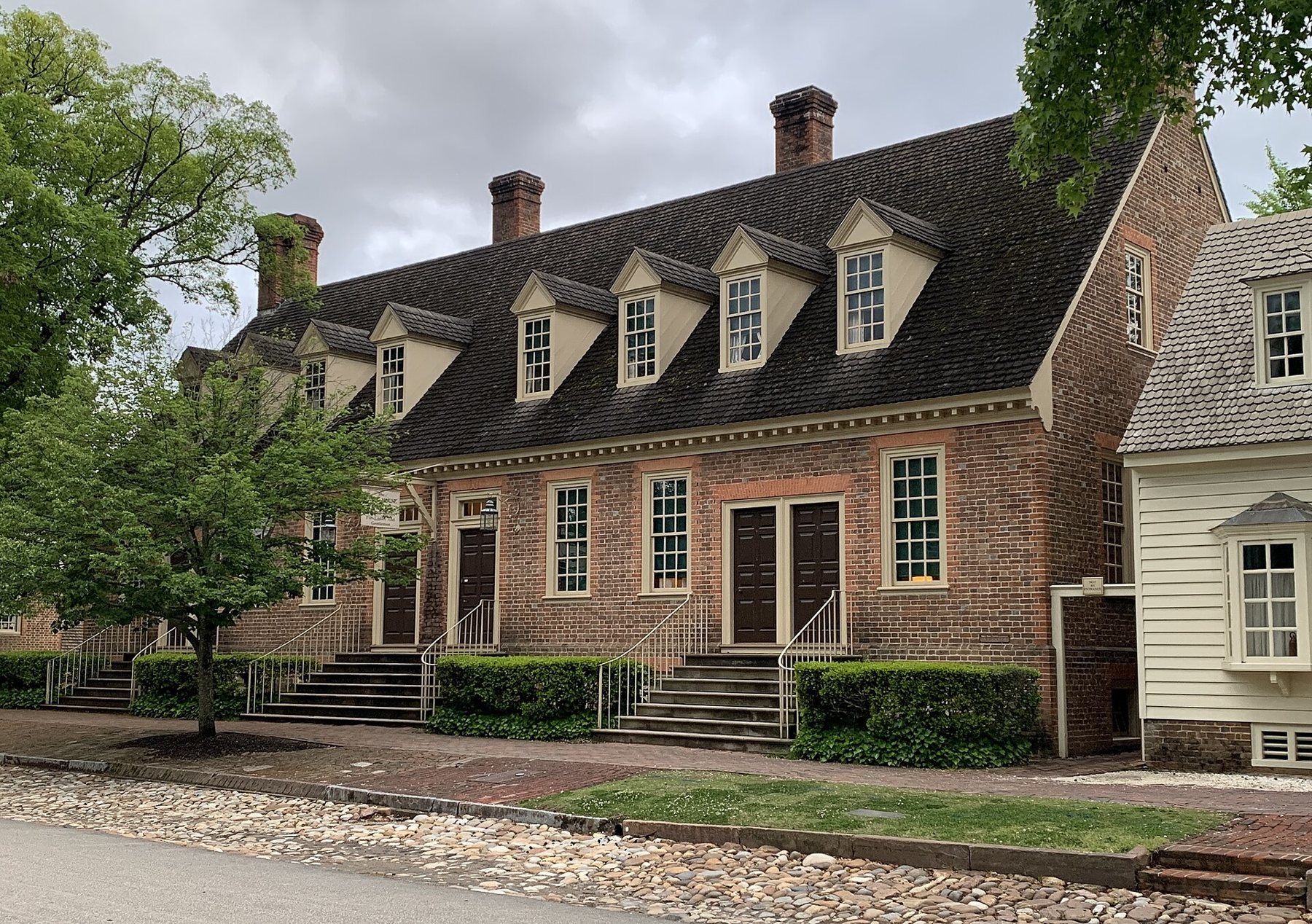
When Virginia's government moved from Jamestown to Middle Plantation in 1699, the new capital was laid out on a plan. A broad main street would run straight along the ridge for about a mile, with the Capitol at its eastern end and the College of William & Mary at its western end. The street was named for the Duke of Gloucester, the young son of the future Queen Anne. Three centuries later it is still the spine of Williamsburg, and walking its length is the simplest way to understand the town.
A town rebuilt
For most of the eighteenth century Williamsburg was the political and social centre of the largest English colony in North America. In 1780, during the Revolution, the capital moved to Richmond, which was easier to defend, and Williamsburg became a quiet market and college town. Many of its colonial buildings decayed or were replaced.
In the 1920s a local rector, W. A. R. Goodwin, persuaded the philanthropist John D. Rockefeller Jr. to fund the restoration of the old town. Over the following decades hundreds of later buildings were removed, surviving colonial buildings were restored, and many lost ones were reconstructed on their original foundations, guided by excavation, insurance records, drawings and a copperplate engraving found in an Oxford library. The result is the living-history museum known as Colonial Williamsburg, which covers most of the old town.
The street you walk today is therefore a mix: a core of genuine eighteenth-century houses and shops, carefully rebuilt public buildings, and a great deal of research about what stood where. It is worth keeping that mix in mind rather than imagining every brick is three hundred years old.
East end: the Capitol
Start at the Capitol, a reconstruction of the building where Virginia's House of Burgesses met. It was here, in 1765, that Patrick Henry spoke against the Stamp Act, and here that Virginia's leaders moved towards independence in 1776. The building is described in more detail on the plate for the Capitol.
From the Capitol, walk west. Along the first blocks you pass the reconstructed Raleigh Tavern, a meeting place for burgesses when the governor dissolved the assembly, and a row of restored shops where tradespeople in period clothes work as blacksmiths, wigmakers, printers and more. The street is closed to cars during the day, so you walk in the middle of it, as people did when it was a busy colonial thoroughfare of carts, horses and market traffic.
The street you walk today is therefore a mix: a core of genuine eighteenth-century houses and shops, carefully rebuilt public buildings, and a great deal of research about what stood where.
Look behind the fronts as you go. Many of the lots run back from the street to gardens, kitchens, smokehouses, wells and stables, laid out in the long, narrow plots of the original town plan. The restored gardens, some with box hedges and kitchen beds, are open to walk through in many places, and they give the town its green, quiet character away from the main street. In spring, with the dogwoods and fruit trees in flower, the back lots are at their best.
The middle: Market Square and the church
Halfway along, the street opens into Market Square, a wide green with the Courthouse, the Magazine and the Guardhouse. The octagonal brick Magazine, built in 1715 to store the colony's arms and gunpowder, is an original building. In April 1775 the royal governor had the gunpowder removed by night, one of the sparks that set Virginia against the Crown.
A neighbouring plate · WilliamsburgThe Governor's Palace and its gardensA rebuilt palace on its original foundationsA little further on, Bruton Parish Church stands in its walled churchyard. The present building dates from the early eighteenth century and is still an active Episcopal church, with services and its own visiting hours. Its interior, with box pews and plain walls, is one of the most authentic colonial spaces in town, and its churchyard holds graves from the colonial era beneath old trees.
Across the street, the long green of the Palace Green runs north to the Governor's Palace, the grandest of the reconstructions.
West end: Merchants Square and the college
West of the church the historic area gives way to Merchants Square, a block of shops built in a colonial style in the 1930s for the modern town. Beyond it the street ends at the gates of the College of William & Mary and the Wren Building, the oldest academic building still standing in the United States, begun in 1695. The plate for the Wren Building tells its story.
Walked straight through, the street takes perhaps half an hour. Walked properly, with stops, side streets and a look into gardens, it fills a morning.
Two side streets are worth a detour. Francis Street and Nicholson Street run parallel to the main street on either side and are quieter, lined with smaller houses, outbuildings and fenced gardens. They give a better sense of everyday colonial Williamsburg than the busy central blocks, and they are often almost empty early in the morning.
In the evening, after the museum buildings close, the street becomes a public promenade again. Lanterns are lit in some seasons, the crowds thin, and the long straight view from the college gates to the Capitol is at its most striking as the light fades. The museum runs ticketed evening programmes at times, from music to ghost-story walks, but the street itself costs nothing to stroll.
What is free and what is not
Walking the street, the greens and many of the gardens costs nothing. Entry to the main buildings, trade shops and programmes requires a ticket from the living-history museum. The college grounds and the parish churchyard are open to respectful visitors, with their own hours. Prices and what is included change, so check before you buy. Even without a ticket, the street gives a strong sense of the town.
Whose town it was
The colonial capital was not only the burgesses, merchants and gentry whose houses line the street. Around half of Williamsburg's eighteenth-century population was enslaved, working in kitchens, stables, shops and fields behind the handsome fronts. Their lives, and those of free Black residents, are the subject of the plate on free and enslaved Williamsburg, and of a growing part of the museum's own programmes. Keep them in mind as you walk; the back lots and outbuildings tell as much as the front doors.
Whatever the season, come early in the day, when the street is quiet and the light is low, or in the weeks before Christmas, when wreaths go up on the doors and the evenings are lit. Bring an umbrella in summer for sudden storms, and good shoes: the gravel and brick paths are uneven, and you will walk more than you expect over a full day.